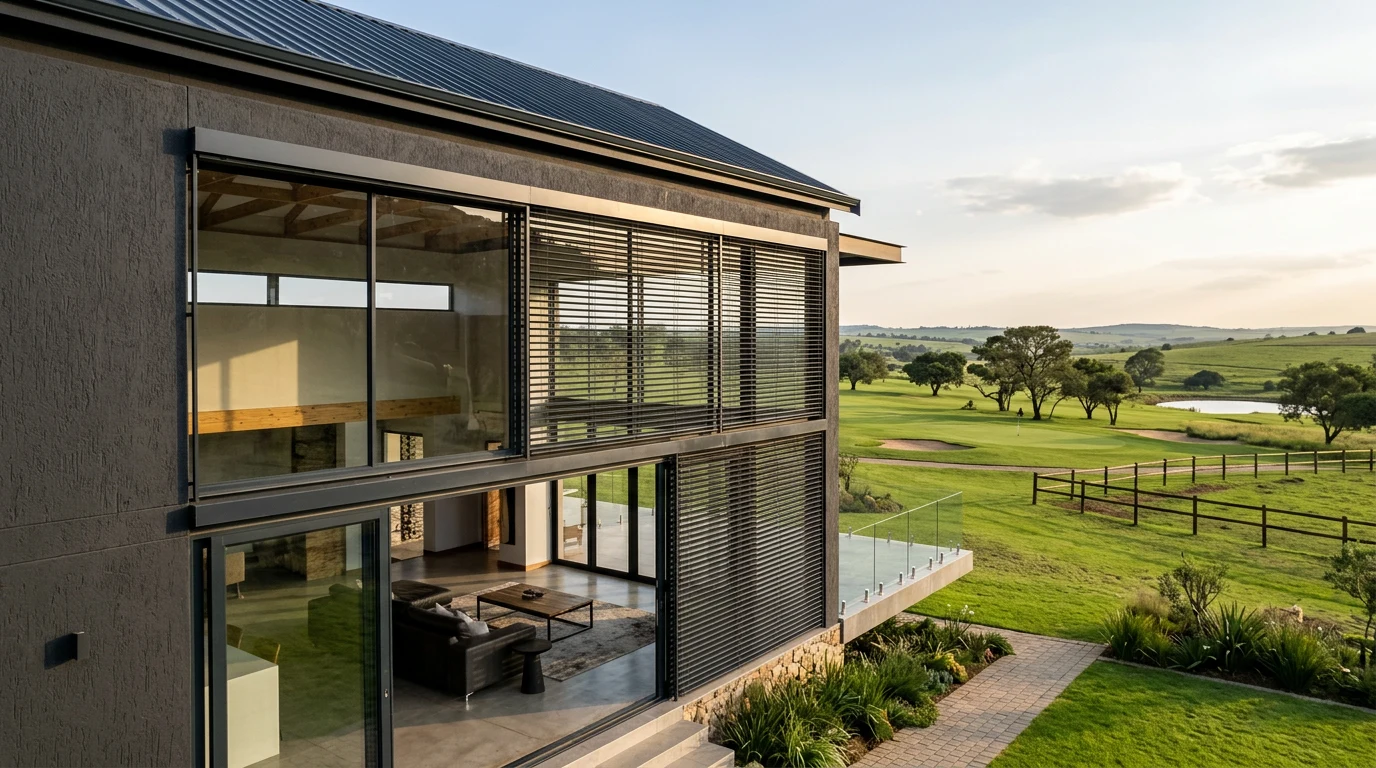
External aluminium venetian blinds mounted outside the glass on a charcoal timber-clad estate home, golden hour light, paddock fencing and open Highveld grassland beyond

Free area guide · Blair Atholl

The Dual-Aspect Light Guide

Fairway on one side, paddocks on the other — what the Highveld sun actually does to a Blair Atholl house, wall by wall, with the trade-offs written down instead of glossed over.

About 9 minutes to read Written August 2026 Free, nothing gated Sources at the foot

01 — The starting point

A dual-aspect house needs its own shading brief

Blair Atholl Golf & Equestrian Estate sits on the R512 Pelindaba Road, roughly three kilometres from Lanseria International Airport.[1][2] It's deliberately low-density: the developer let owners commission their own architects rather than build to one house type, so the estate reads as individual, architect-designed homes rather than a repeated pattern.[6]

Most of those homes share one thing regardless of style: they're built dual-aspect, living areas toward the Gary Player-designed fairway, bedrooms toward the paddocks or a riding arena.[5] That's two full walls of glass doing two different jobs, not one wall with an obvious single answer — the reason a generic shading brief runs out of road here fast. The estate is also nearing full build-out, its final eighty stands released for purchase[7] — for anyone still finishing a build, a concealed blind box or a motor's wiring belongs in the ceiling plan now, not added afterwards.

02 — The light here

What the Highveld sun actually does over Blair Atholl

Blair Atholl sits at roughly 25.93°S, at an altitude close to 1,360 m.[3][4] No sun-path dataset has been published for Lanseria itself, so the numbers below use Johannesburg at 26.19°S — about 0.3° further south, a difference small enough that any household spec would round it away.[11]

On 21 December, the sun rises at 05:12 (bearing 116°) and sets at 18:59 (243°), reaching almost 87° at solar noon — close enough to overhead that a modest eave stops most of the midday heat.[11] On 20 June, sunrise is 06:55 (69°), sunset 17:25 (295°), and solar noon sits at just 40° — low enough to reach deep into a north-facing room, which in a Highveld winter is warmth worth keeping, not blocking.[11]

Two more facts that change the specification

Storm and hail season runs roughly October to March. The Gauteng Highveld averages about thirteen supercell events across seven event days a season, each lasting around an hour and twelve minutes and tracking roughly 49 km — long enough to cross an estate this size in one pass — peaking in October and November.[9] Anything left extended outside the glass through those months needs a wind sensor as standard, not an extra.

Altitude lifts the UV. Ultraviolet intensity rises roughly ten percent per thousand metres of elevation, and the Johannesburg-area UV Index typically runs 11–13 through peak season.[10] That's a fabric-durability argument as much as a comfort one — the honest reason to specify UV-stable exterior fabric on anything living outside the glass.

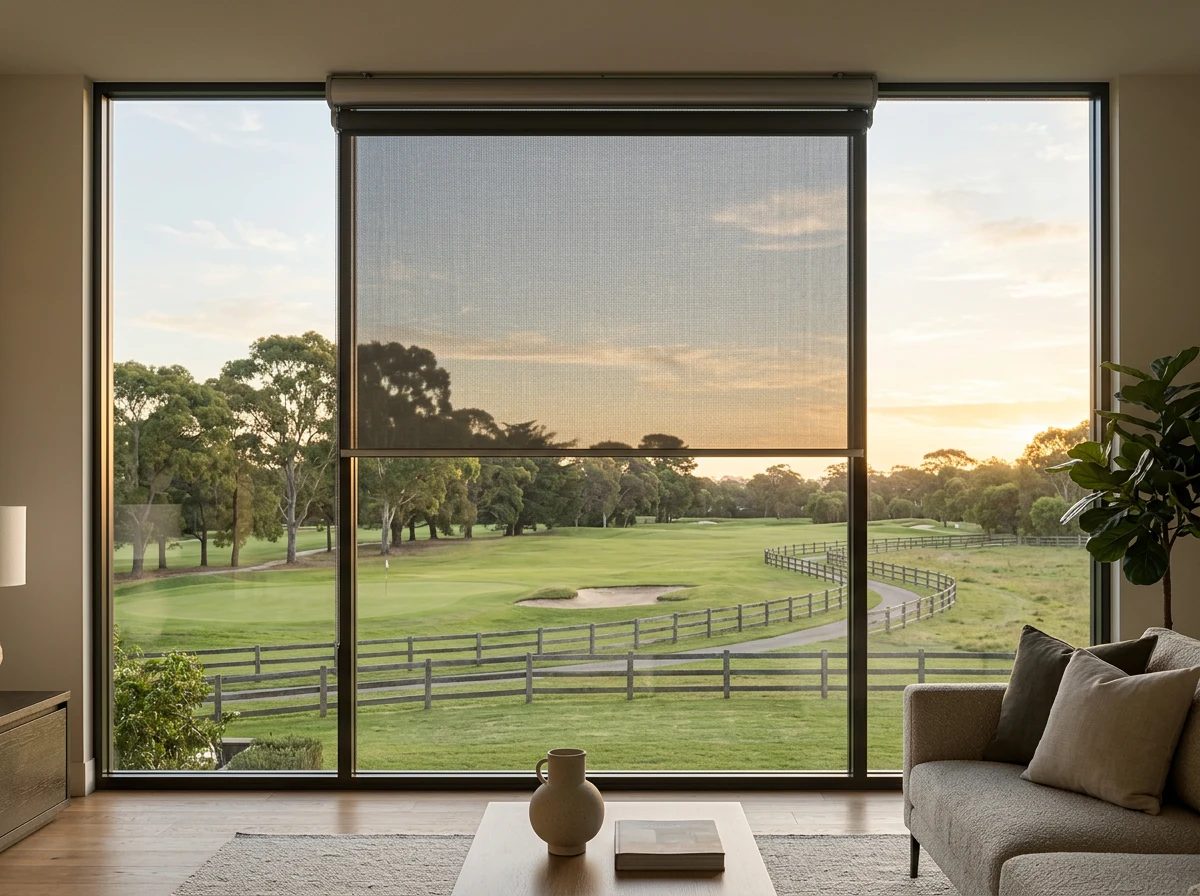
Sunscreen roller blind — a single flat sheet of open-weave fabric on a tube — lowered halfway across a west-facing window, golf fairway and paddock fencing visible through the weave at sunset

Four o'clock, west elevation

An open weave holds the glare down without losing the fairway.

03 — Room by room

Elevation by elevation, and which rooms suffer

One house, four different problems — work out which wall a room sits on first.

North

Protect in summer, open in winter

Near-overhead in December, so an ordinary eave does most of the midday work, then down at 40° and pouring in by June.[11] These rooms want something you can angle — summer sun bounced off the ceiling, opened flat for June's free warmth.

Verdict: adjustable beats absolute.

West

The wall with no season off

Sunset's bearing swings between 243° in December and 295° in June — south-west to north-west, every day of the year.[11] A west room takes low, direct sun at the end of every afternoon, all year — the wall that decides if it's usable at four o'clock.

Verdict: stop it outside the glass wherever you can.

East

Early light, not heat

The geometry mirrors west,[11] but the effect is gentler — the air is still cool at 05:12 in midsummer, so it reads as an early-glare, early-wake problem for bedrooms rather than a heat one.

Verdict: solve for glare and sleep, not heat.

South

Paddock glare, and the coldest walls

Almost no direct sun reaches a true south wall here, but grass, sand arenas and pale stone throw bounced glare back into the room most of the day — and these stay the coldest rooms on a Highveld winter morning.

Verdict: think bounced glare and warmth, not sun.

Optional

Want this marked up against your own rooms?

Tell us which walls are giving you trouble and we'll send this guide back with your elevations noted against it. It's an email, not a visit — nobody phones you about it.

POPIA: used only to send you this guide and, if you ask for it, to arrange your free measure. Never shared with third parties.

04 — The specification

What we'd fit here, and the honest catch with each

Each of these is right somewhere on this estate and wrong somewhere else. Tick anything that sounds like your problem — it carries straight into the form below.

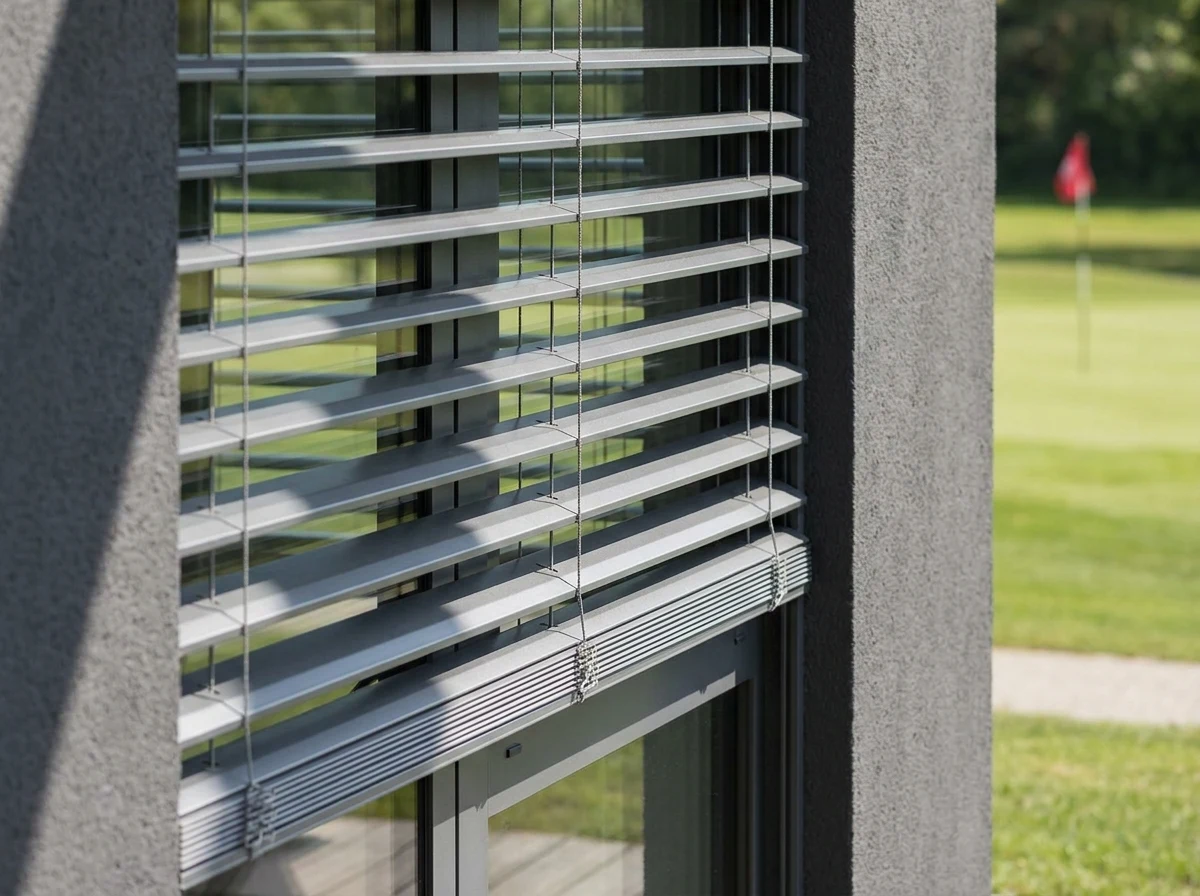
Close-up of external aluminium venetian blind slats mounted outside a window, angled against the sun, with a golf green and flag visible beyond

West & north-west glass · the fairway wall

External venetian blinds

On the wall with no season off, we'd specify external venetians over an interior blockout roller — physics, not preference. Stopping the sun before it reaches the pane keeps a room cooler than absorbing it inside, where the glass still warms and radiates back in all evening. Slats close for a full block or tilt for filtered light.

The most visible change to the outside of the house — the aesthetics committee sees it first. Living outdoors through hail season also means specifying for wind, not only sun.
Fairway-facing living areas

Sunscreen roller blinds

A single flat sheet of open-weave fabric on a tube — no folds. The workhorse for rooms built to look at the course: cuts glare and UV while keeping the fairway readable through the weave, well below the cost of an exterior system.

Gives daytime privacy but reverses after dark — lights on inside make the room visible from the fairway path. Pair with a blockout on the same bracket for a room that also needs full dark.

The hardest west & north-west glass

Roller shutters

Rigid aluminium slats rolling down from a headbox outside the building — full blackout, full heat-stop, and one motor to manage before a Highveld storm rolls in. On the toughest west rooms this is close to the ceiling of what a blind can do for heat.

Shading, not security. Made for sun, heat and glare control outside the glass — not security-rated. That's a different product, quoted separately on request.

Sits outdoors through storm season, so we specify a wind sensor as standard, never an upsell.

Studies & north-facing living rooms

Timber venetian blinds

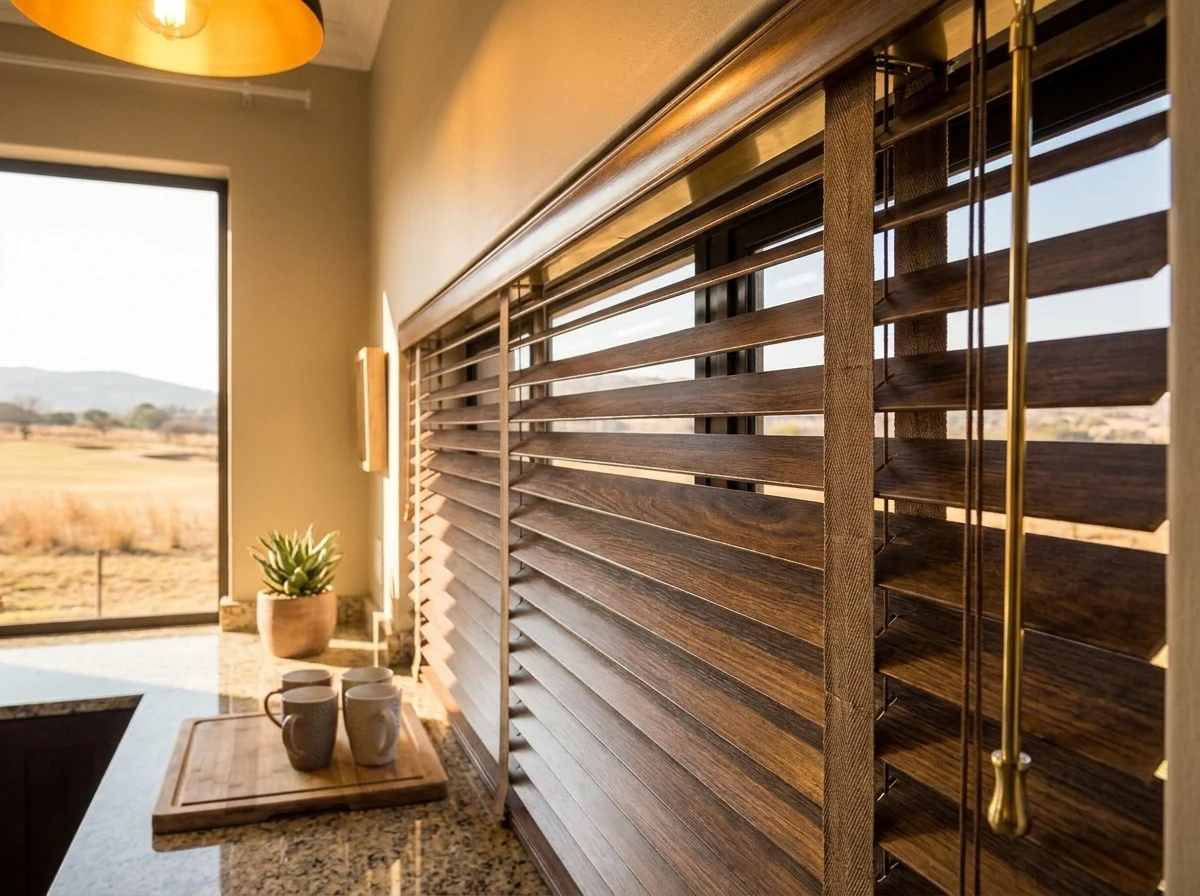
Where light needs angling rather than blocking — the modest winter sun on a north wall, or a study whose light shifts through the day — timber slats throw summer sun onto the ceiling and open flat for June's low sun.

Heavier and dearer than aluminium; a wide run splits across two headrails. Near a scullery we'd switch to aluminium — timber and moisture age badly together.

Double-volume rooms

Cellular honeycomb blinds

Trapped-air cells hold a still layer against the glass, insulating rather than just shading — the answer for a double-volume room that bakes by day and goes cold on a Highveld night, when July lows sit near 3.9°C.[8]

Not a blockout product on its own, and the pleated fabric wants a light vacuum, not a wipe.

The braai patio & entertaining side

Folding-arm awnings

Where the garden is the extra room, an awning over the paving usually buys more comfort than anything done to a window — and folds flat for winter sun when you want it back.

Extended fabric is a shade product, not a storm product. In a belt that takes Highveld supercells roughly October to March,[9] we specify a wind-sensor motor as standard, so it retracts itself before a gust arrives.

Also in the range: blockout rollers for paddock-facing bedrooms, day & night zebra blinds, aluminium venetians where timber won't last, concealed recessed boxes for new builds, skylight & shaped blinds for gable glass, zip screens, motorisation across multi-blind walls, and repairs on anything already fitted — including work we didn't originally supply.

Timber venetian blind slats above a kitchen counter, warm wood grain on charcoal fabric tapes with a brass tilt cord, open Highveld view through the glass

Ink, bone and brass

Warm timber slats, the same brass hardware most homes here already run.

05 — The local constraint

Estate sign-off — what we know, and what we don't

Like most secure estates on this side of Johannesburg, changing anything visible from outside a Blair Atholl house usually needs sign-off from an aesthetics or architectural committee. The estate's own published guidelines describe a nonrestrictive framework for the initial build — three years to start, eighteen months to complete, solar panels and water heating explicitly permitted — but say nothing in public about ongoing changes to exterior shading after move-in.[2]

We supply spec sheets and neutral colour samples with every quote, and on the measure we'll say plainly which recommendations touch the outside of the house. The sign-off itself is your estate's call rather than ours, so confirm current requirements with your body corporate before ordering anything exterior. The same logic plays out down the road, too — see Dainfern, Broadacres & Cedar Lakes, Steyn City and Helderfontein Estate.

06 — The honest limit of a guide

What we'd still need to check on site

Everything above is what we know about Blair Atholl. What no guide knows is your house — and these are the five things that actually decide the specification.

  1. Exact bearing, not just "west"

    Twenty degrees is the difference between a wall that catches the sun for an hour and one that catches it for four — we take a compass reading at the window, not an assumption from the site plan.

  2. Reveal depth, and what the wall is made of

    Depth decides whether a blind, or a headbox, fits inside the opening at all. Steel glazing, timber cladding and a plastered stud wall all take fixings differently.

  3. Wind exposure at that specific stand

    A sheltered courtyard and an open, fairway-facing corner see genuinely different exposure — that's what decides the wind-sensor spec on anything left outside the glass.

  4. Where the power actually is

    A motorised system lives or dies on the walk from a power point to the window head. For a wired option, that's a conversation with your electrician, not a guess from a plan.

  5. Your estate's current sign-off requirements

    We can't quote them from here — a call to your body corporate before the measure saves a round trip on any exterior product.

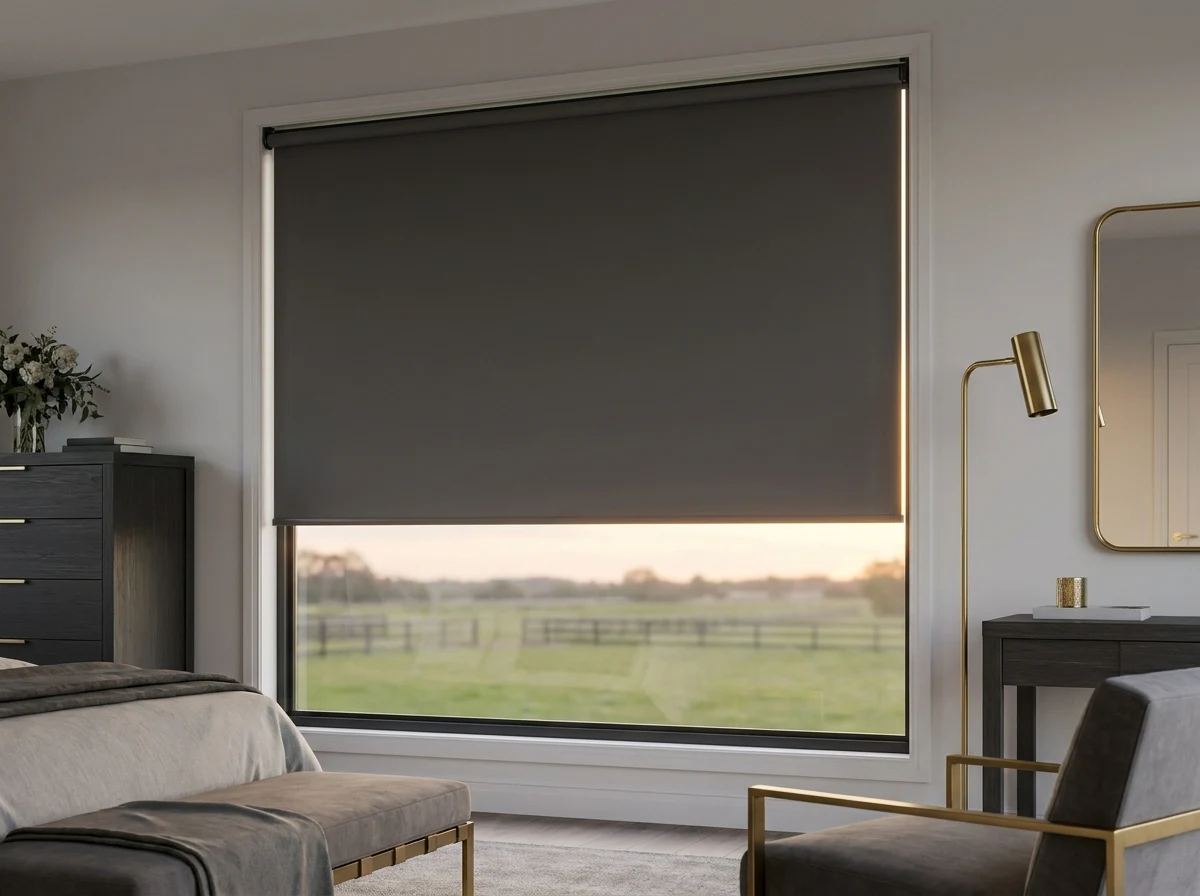
Blockout roller blind — a single flat sheet of light-stopping fabric, no folds — lowered over a bedroom window at dusk, paddock fencing visible at the edge of the glass, brass floor lamp in the foreground

The paddock side, after dark

Full block for sleep, without losing the room's own quiet detailing.

07 — Two ways forward

Now let's look at your actual windows

A consultant measuring on site beats any guide, however researched. Prefer a rough number first? The window list under the form does that — never louder than the free measure, always sitting quietly beside it.

The dominant path

Book your free expert measure

A consultant comes out to Blair Atholl with samples, measures every opening properly, and leaves you a written quote per window. It costs nothing and commits you to nothing.

What are you interested in? (tick any)
Want a ballpark first? Open this — about two minutes.

Blair Atholl Blinds — window list

Walk the house, fill this in by hand, then type it into the form on blairathollblinds.co.za when you get back. Measure width first, then drop, in millimetres.

Pop in rough sizes and we'll send a budget range by the next working day. Not sure how to measure? Leave it blank — our consultant measures for free and you'll get exact per-window pricing either way. This is entirely optional and nothing here is binding.

Room Width (mm) Drop (mm) Inside or outside the reveal Product Remove

Nothing on the list yet — and that is completely fine.

Anything entered here rides along with your enquiry as plain text. No uploads, no third-party services, nothing stored anywhere else. If photographs would help, a consultant will simply ask for them in reply.

POPIA: used only to arrange your free measure and quote call-back, and never shared with third parties. If you tell us you're still researching, we won't phone you.

Our consultant does five to six measures a week across this area, so book ahead if you need a particular day.

Not ready yet

Just take the guide, marked up

Prefer to think it over? Tell us which rooms are the problem and we'll email this guide back with your own elevations noted against it — no visit, no call.

Working out

Sources

Every climate, geography, suburb and regulation claim above traces back to one of these. Where we've reasoned from the numbers instead of citing something directly, we've said so in the text.

  1. Blair Atholl Golf & Equestrian Estate — official estate site, R512 Pelindaba Road corridor. blairatholl.co.za
  2. "Come Home to Blair Atholl" — roughly 3 km from Lanseria International Airport; views toward the Magaliesberg, the Cradle of Humankind and the Crocodile River; nonrestrictive architectural building guidelines with three years to start building and eighteen months to complete; solar panels and water-heating systems explicitly permitted. estate-living.co.za — Come Home to Blair Atholl
  3. Lanseria, South Africa — coordinates approximately 25.93°S, 27.93°E, altitude roughly 1,360–1,377 m. latlong.net — Lanseria
  4. Lanseria International Airport — altitude cross-check. en.wikipedia.org/wiki/Lanseria_International_Airport
  5. Blair Atholl Golf & Equestrian — an 8,232-yard championship course designed by Gary Player, opened 2007. golfdigest.com — Blair Atholl
  6. "A serene oasis designed to offer tranquillity and luxurious comfort" — the estate's low-density approach and its use of independent architects. sabuildingreview.co.za
  7. Blair Atholl Golf & Equestrian Estate releases final 80 vacant stands for purchase. privateproperty.co.za
  8. Average weather at Lanseria International Airport — coldest month July (≈3.9°C average low), hottest month February (≈28.3°C average high), windiest month September, rain pattern early September to mid-May. weatherspark.com — Lanseria International Airport
  9. Characteristics of warm-season supercell thunderstorms over the Gauteng and Mpumalanga Provinces of South Africa — Highveld storm season, supercell frequency, duration and track length, seasonal peak. University of Pretoria repository
  10. South Africa UV Index guide — UV rising roughly 10% per 1,000 m of altitude; Johannesburg-area UV Index typically 11–13 in peak season. koolasun.co.za
  11. Johannesburg, South Africa, sun data — solar noon elevation and sunrise/sunset bearings for the December and June solstices. gaisma.com — Johannesburg
  12. SANS 10400-XA:2021 (Edition 2) — the fenestration-calculation threshold rising from 15% to 20% of floor area; energy zones renamed from climatic zones, Gauteng in Zone 1; solar-heat-gain requirements no longer distinguished between west-, north- and east-facing glazing. roosarchitects.co.za

Three honest caveats. No sun-path dataset has been published for Lanseria itself, so this guide uses the published Johannesburg figures and states that ~0.3° difference openly rather than inventing new numbers. No suburb-level hail or wind dataset exists for Blair Atholl specifically — every storm figure above is Highveld- or Gauteng-wide, presented that way rather than as a site-specific measurement. And no published document sets out an aesthetics committee's requirements for exterior shading products at Blair Atholl — the estate-sign-off section above says only the general and honest thing, which is that most secure estates of this kind run some process, and that we haven't seen this one's.

Ready when you are

Let's get your windows measured properly.

Tell us about your home and one of our expert consultants will be in touch to arrange your free in-home measure and written quote.